
EOS - Laser Tutorials
EOS Dynamics Learning Center
Laser Tutorials
Engineering-Oriented Laser Fundamentals
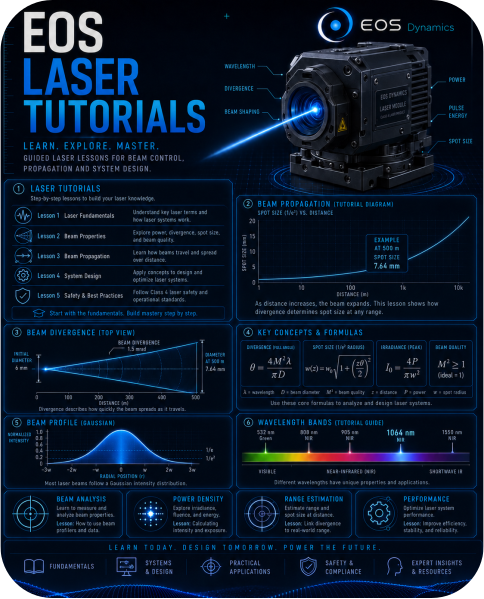
This tutorial page explains the main laser parameters used in electro-optical systems, laser illuminators, range finders, beam shaping modules and high-power diode laser assemblies. The goal is not only to define terms, but to connect them with real engineering decisions: beam size, divergence, power density, atmospheric loss, optical safety, eyewear selection and practical system design.
Laser Power, Energy and Pulse Parameters
A laser source cannot be evaluated by output power alone. For continuous-wave lasers, optical power in watts is usually the main quantity. For pulsed lasers, pulse energy, pulse width and repetition rate must also be considered. Two systems with the same average power may have completely different peak power and safety risk if their pulse durations are different.
Core relations
Average Power
Pavg = Epulse × PRF
Peak Power
Ppeak = Epulse / τ
Duty Cycle
Duty = τ × PRF
| Parameter | Typical Unit | Engineering Meaning |
|---|---|---|
| Optical Power | W | Continuous or average optical output from the laser. |
| Pulse Energy | J / mJ / µJ | Energy delivered in one laser pulse. |
| Pulse Width | ns / µs / ms | Temporal duration of one pulse. |
| Repetition Rate | Hz / kHz | Number of pulses emitted per second. |
| Peak Power | W / kW / MW | Instantaneous power during the pulse; often much higher than average power. |
Engineering note:
When comparing lasers, always check whether the stated power is CW power, average optical power,
peak power or electrical input power. These are not interchangeable.
Beam Diameter, Divergence and Spot Size
Laser beam diameter at distance is controlled by initial beam size and angular divergence. In first-order engineering calculations, if divergence is given as full-angle divergence, the beam diameter growth can be estimated directly with distance.
First-order beam growth
Circular equivalent beam
D(z) = D0 + θ × z
Horizontal axis
Wx(z) = Wx0 + θx × z
Vertical axis
Wy(z) = Wy0 + θy × z
| Definition | What to Check | Why It Matters |
|---|---|---|
| Full-angle divergence | Total angular spread of the beam cone. | Can be directly used in first-order beam diameter growth. |
| Half-angle divergence | Angular spread from beam axis to one side. | Must be doubled if your formula expects full-angle divergence. |
| 1/e² diameter | Common Gaussian beam diameter definition. | Different from FWHM or mechanical aperture diameter. |
| Rectangular beam size | Separate X and Y beam dimensions. | Critical for diode bars, laser arrays and beam-shaped outputs. |
Diffraction limit and M² beam quality
Ideal full-angle divergence
θDL ≈ 4λ / (πD)
Real beam divergence
θreal ≈ M² × θDL
Beam quality interpretation
M² = 1 ideal, M² > 1 real beam
A perfect Gaussian beam has M² = 1. Real lasers usually have M² values greater than 1. Single-mode lasers may stay close to the diffraction limit, while multimode diode lasers and diode-bar systems can have different beam quality values in the horizontal and vertical axes. For this reason, high-power rectangular laser systems should be evaluated with separate X/Y beam size and divergence values.
Important:
Many datasheets do not clearly state whether divergence is full-angle or half-angle.
This single mistake can create a factor-of-two error in spot size and power density.
In addition, if M² is ignored, a real multimode laser may be incorrectly treated as an ideal diffraction-limited beam.
Circular vs Rectangular Laser Beams
Many theoretical laser calculations assume circular Gaussian beams. However, high-power diode lasers, laser bar arrays and beam-shaped modules often produce rectangular or elliptical beams. In these systems, horizontal and vertical divergence must be treated separately.
| Beam Type | Recommended Calculation | Typical Application |
|---|---|---|
| Circular Gaussian | Use equivalent diameter, waist and divergence. | Single-mode lasers, lab beams, well-collimated sources. |
| Elliptical Beam | Use major/minor axis values separately. | Diode lasers, asymmetric collimation, astigmatic beams. |
| Rectangular Beam | Use width, height, horizontal divergence and vertical divergence. | Laser diode bars, array modules, shaped illuminators. |
| Beam-Shaped Output | Use measured or specified footprint after optics. | FAC/SAC optics, homogenizers, expanders, custom modules. |
Rectangular beam area
Area at range
A(z) = Wx(z) × Wy(z)
Irradiance
E = P / A
EOS Dynamics note:
For high-power diode array products such as rectangular-output laser modules, X/Y beam growth
is usually more meaningful than circular equivalent beam diameter.
Irradiance, Fluence and Peak Power
Total laser power does not tell the whole story. A 10 W laser spread over a large area may be moderate, while the same 10 W concentrated into a small spot can be hazardous or damaging. Power density and energy density are therefore central laser engineering quantities.
Power and energy density
CW irradiance
E = P / A
Pulse fluence
H = Epulse / A
Peak irradiance
Epeak = Ppeak / A
| Quantity | Unit | Used For |
|---|---|---|
| Irradiance | W/cm² or W/m² | CW illumination, thermal loading, detector signal and safety screening. |
| Fluence | J/cm² | Pulsed laser exposure and optical damage threshold comparison. |
| Peak Irradiance | W/cm² | Short-pulse optical damage and nonlinear effects. |
Engineering note:
For optical components, compare the calculated fluence or peak irradiance with the manufacturer’s
laser-induced damage threshold. Coating, wavelength, pulse duration and beam size all matter.
Beam Expanders and Divergence Reduction
A beam expander increases beam diameter and reduces divergence in an ideal first-order sense. This can reduce spot size at long distance and increase power density on target. However, the expander must have sufficient clear aperture, optical quality, alignment stability and coating performance.
Ideal beam expander relations
Output diameter
Dout = M × Din
Output divergence
θout = θin / M
Output power
Pout = Pin × T
| Design Factor | Risk if Ignored |
|---|---|
| Clear aperture | Beam clipping, power loss and unwanted diffraction. |
| Wavefront error | Beam quality degradation and larger far-field spot. |
| Coating transmission | Reduced delivered power and increased heating. |
| Mechanical alignment | Pointing error, beam walk-off and boresight shift. |
Practical note:
For rectangular beams, expansion may be required only in one axis or may use different magnification
ratios for fast and slow axes.
Atmospheric Attenuation, Fog, Rain and Scattering
Outdoor laser propagation is affected by molecular absorption, aerosol scattering, fog, haze, rain, snow and turbulence. The most common screening approach is to use an extinction coefficient and Beer–Lambert transmission. For serious range performance prediction, measured atmospheric data or radiative transfer tools should be used.
Atmospheric transmission
Beer–Lambert law
T = exp(-β × R)
Remaining power
P(R) = P0 × T
Visibility screening
β ≈ 3.912/V × (λ/0.55)^(-q)
| Condition | Typical Effect | Engineering Comment |
|---|---|---|
| Clear air | Low attenuation | Usually acceptable for preliminary calculations. |
| Haze / aerosol | Moderate scattering | Can strongly affect visible and near-IR propagation. |
| Fog | Severe scattering | Often dominates system performance; visibility-based models become approximate. |
| Rain / snow | Scattering and absorption | Drop size, rate and wavelength dependence matter. |
Important:
A simple atmospheric calculator gives screening results only. For procurement, field prediction
or military-grade performance claims, use measured extinction data, MODTRAN/LOWTRAN-type analysis
or controlled environmental testing.
Laser Safety: MPE, NOHD, OD and EN 207 Eyewear Markings
Laser safety is not determined by power alone. Wavelength, exposure duration, pulse structure, beam diameter, divergence, viewing geometry and applicable standard all affect the hazard. A calculator can support preliminary screening, but official laser classification and PPE selection must follow the relevant standard and qualified safety assessment.
Eyewear OD concept
Optical density
OD = log10(Exposure / MPE)
Transmission
T = 10^(-OD)
| Marking | Meaning | Example |
|---|---|---|
| OD | Logarithmic attenuation at a wavelength or wavelength band. | OD 6+ at 1064 nm |
| LB rating | EN 207 protection rating including damage resistance testing. | 1064 nm R LB7 |
| D | Continuous wave / long exposure protection. | D 1064 nm LB6 |
| I | Long pulse protection. | I 1064 nm LB6 |
| R | Q-switched / nanosecond pulse protection. | R 1064 nm LB7 |
| M | Mode-locked / ultrashort pulse protection. | M wavelength range LB rating |
Purchase warning:
Do not buy eyewear that only says “laser protection” or only lists a wavelength.
The datasheet should explicitly show wavelength range, OD, EN 207 LB marking,
operating mode, visible light transmission, frame type and certification.
Practical Laser Design Checklist
A laser module should be evaluated as an optical, thermal, mechanical, electrical and safety-critical subsystem. The following checklist can be used during early design review, supplier discussion or customer requirement analysis.
Final engineering rule:
Never approve a laser design based only on nominal output power. Beam geometry, power density,
atmosphere, optics, thermal load and safety limits must be evaluated together.
Reference Standards and Engineering Basis
This tutorial uses widely accepted laser engineering concepts and safety terminology. For official safety classification, eyewear certification and product compliance, always consult the latest applicable standards and qualified laser safety personnel.
| Topic | Reference Basis |
|---|---|
| Laser product classification | IEC 60825-1 laser product safety classification and accessible emission limit framework. |
| Maximum permissible exposure | IEC / ANSI laser safety exposure limit methodology. |
| Laser protective eyewear | EN 207 LB rating, OD, wavelength range and D/I/R/M operating-mode markings. |
| Gaussian beam optics | Gaussian beam propagation, 1/e² beam diameter, waist and divergence concepts. |
| Atmospheric attenuation | Beer–Lambert transmission and visibility-based extinction screening models. |
Disclaimer:
The content is intended for engineering education and preliminary design screening.
It must not be used as a substitute for certified laser safety assessment, legal compliance,
product certification or formal military/industrial qualification testing.
